
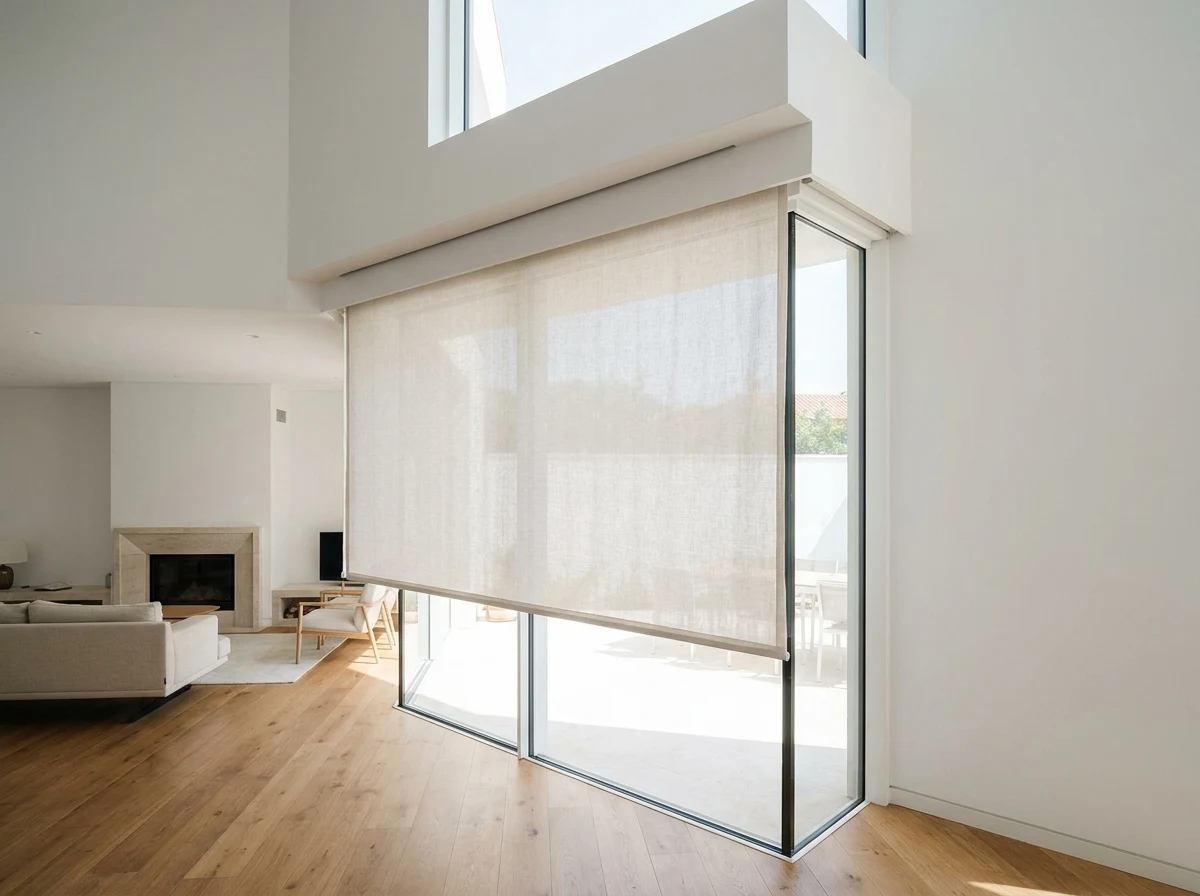
Blinds designed into the building, not onto it
A concealed or recessed blind drops from a slim ceiling slot or bulkhead recess rather than a surface-mounted headrail. Raise it, and the window is completely clean — glass, frame, nothing else interrupting the sightline. On Baronetcy’s frameless, double-volume glazing, that clean line is often the entire point of the room, and a bolted-on headrail undoes it.
Why this suits Baronetcy’s brief specifically
Baronetcy’s architectural guidelines push toward open-plan homes with minimal detailing — some carrying a named architect’s signature. That’s exactly the brief a concealed system answers best: it disappears into the ceiling plane instead of competing with it. The trade-off is timing. The recess needs roughly 110–150mm of ceiling depth depending on the tube and fabric drop, so it’s far cleaner to plan in at the design or renovation stage than to retrofit into a finished ceiling. Retrofit is still possible with a surface bulkhead or a slim cassette pelmet colour-matched to the ceiling — just not quite as invisible.
- Recess depth of roughly 110–150mm, confirmed against the exact system at quote stage
- Almost always motorised — reaching into a ceiling slot by hand defeats the point
- Coordinated with downlights, aircon slots and curtain pelmets at design stage
- Retrofit possible via a slim surface bulkhead where a true recess isn’t practical
Honest limitation
This is a premium, coordination-heavy system — it needs the recess to physically exist or be built in. If you’re planning a renovation that opens up new glazing, involve us at the drawing stage; retrofitting a clean recess after the ceiling is finished is possible but never quite as invisible as planning it in.
What a concealed system costs here
Recessing a blind so nothing shows when it is up is as much a building detail as a blind, and the guide reflects it: R1,600 to R3,000 per square metre installed for a hand-operated concealed system, and R3,200 to R5,000 motorised. A ceiling void already framed for it is a different job from a bulkhead that has to be formed or cut back.
Two things sit outside that rate. Building work to make the recess, and any electrical point for a wired motor, belong to the trades doing that work; we will say plainly at the measure which of those your ceiling needs. Small openings attract a minimum. Everything is priced in writing, per opening, after the free measure — and on a concealed job that measure is worth booking before the ceilings close, not after.